
Pricing Details
Starter: $25 per month; includes 100 credits, unlimited projects, full Agentic mode access, and email support. Growth: $69 per month; includes 250 credits, full codebase export, custom domains, and a dedicated WhatsApp support channel. Professional: $129 per month; includes 500 credits, all Growth features, premium support, and early access to new features. Business: $299 per month; includes 1,000 credits, all Professional features, a dedicated success manager, and custom integrations. Mini Pack: $9 one-time; includes 20 credits, one small project build and test, and full Agentic mode access. Disclaimer: Please note that pricing information may not be up to date. For the most accurate and current pricing details, refer to the official Capacity website.
Product Visuals (1 images)
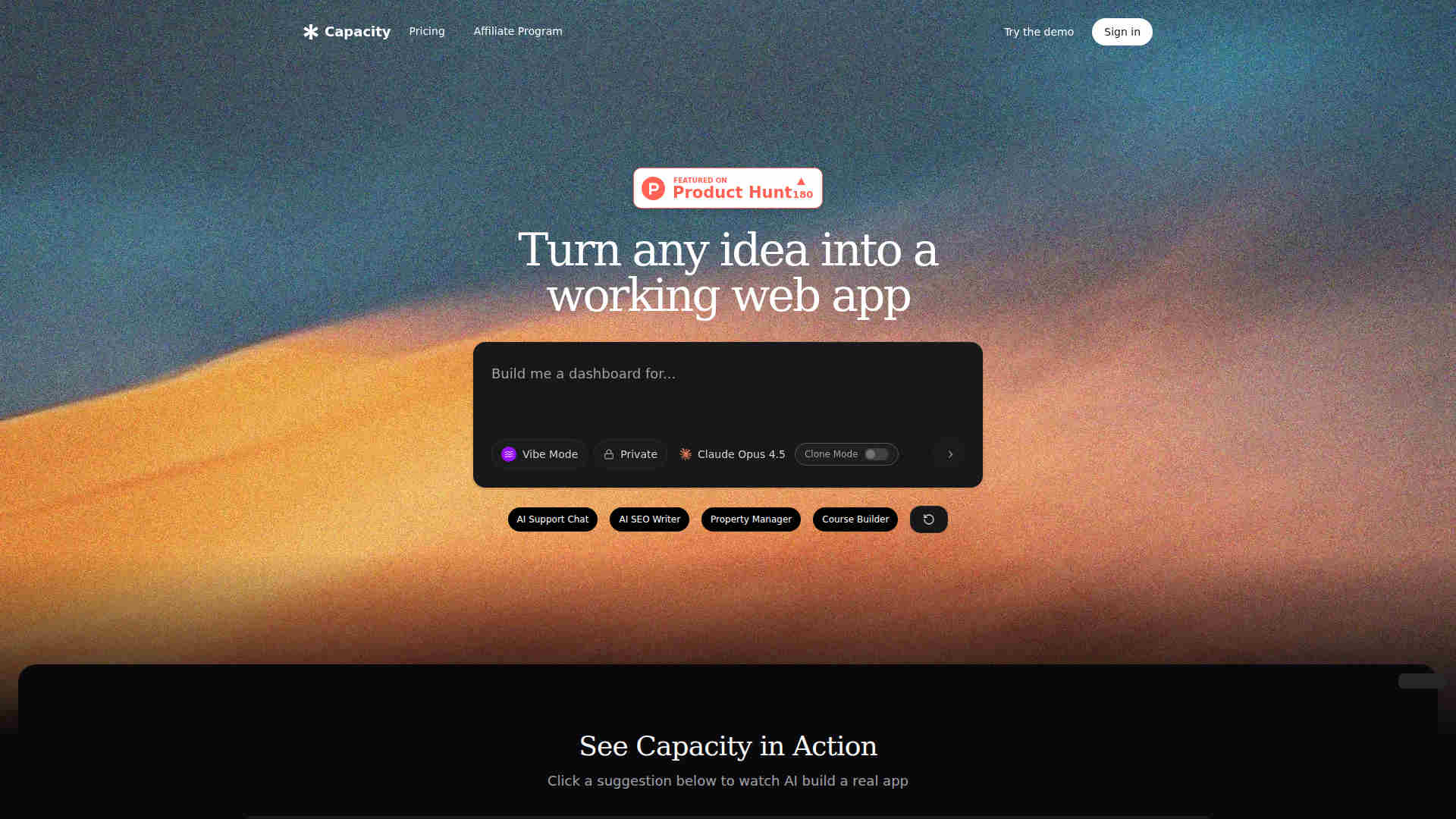
Strengths
- Production‑oriented flow: Spec Coding pushes users toward clear requirements and better architecture, which suits serious apps more than one‑off prototypes.
- Fast MVP creation: Founders can go from idea to working MVP in minutes or hours instead of months, which is attractive for validation and experimentation.
- Modern tech stack: Output uses widely adopted web technologies, making handoff to human developers or later customization much easier.
- Non‑coders friendly: Many workflows are chat‑driven, so non‑technical founders can still get functional apps without writing code.
- Flexible usage model: Credit billing with optional one‑time “mini packs” fits both light tinkerers and heavier, ongoing projects.
Limitations
- Learning curve for specs: Users who are used to pure prompting may need time to adjust to writing structured briefs and UX specs.
- Credit complexity: New users must understand how credits map to tasks, which can initially feel opaque compared with simple per‑seat pricing.
- Web‑app focus: Great for full‑stack web apps, but less relevant for native mobile or highly specialized back‑end workloads.
What You Get
Key Features
- Spec Coding methodology: Structured, specification‑first flow (brief, UX, design) so AI generates code that follows clearly defined requirements instead of guessing from vague prompts.
- AI Cofounder workspace: An AI “cofounder” that helps brainstorm ideas, refine concepts, and translate them into scoped features and coding tasks, keeping product vision and implementation aligned.
- True agentic coding: Project‑aware AI agents that understand the codebase, support multi‑file refactors with dependency tracking, and automatically fix many errors and bugs across files.
- Full‑stack generation: Builds database‑backed apps with auth, storage, and real‑time updates on top of Supabase, along with frontend and backend code in a production‑ready stack.
- Credit‑based workflow: Every interaction with the AI uses credits based on task complexity, which lets users scale usage from quick tests to large projects without changing tools.
- Code export and hosting: Users can export the entire codebase, connect GitHub, and still rely on Capacity’s managed hosting when they do not want to run infrastructure themselves.
- ProsProduction‑oriented flow: Spec Coding pushes users toward clear requirements and better architecture, which suits serious apps more than one‑off prototypes.Fast MVP creation: Founders can go from idea to working MVP in minutes or hours instead of months, which is attractive for validation and experimentation.Modern tech stack: Output uses widely adopted web technologies, making handoff to human developers or later customization much easier.Non‑coders friendly: Many workflows are chat‑driven, so non‑technical founders can still get functional apps without writing code.Flexible usage model: Credit billing with optional one‑time “mini packs” fits both light tinkerers and heavier, ongoing projects.ConsLearning curve for specs: Users who are used to pure prompting may need time to adjust to writing structured briefs and UX specs.Credit complexity: New users must understand how credits map to tasks, which can initially feel opaque compared with simple per‑seat pricing.Web‑app focus: Great for full‑stack web apps, but less relevant for native mobile or highly specialized back‑end workloads.
Best For
- Solo founders and indie hackers: Validating SaaS or marketplace ideas quickly without hiring developers.
- Startup product teams: Spiking features, building internal tools, and iterating on product experiments.
- Agencies and studios: Producing client MVPs, dashboards, and custom CRMs faster while still delivering exportable code.
- Internal ops and IT teams: Spinning up internal portals, booking tools, or inventory systems on top of existing data.
- Uncommon Use Cases: Educators using it to demonstrate full‑stack architecture with AI assistance; content creators building niche AI tools like SEO writers or AI support chat widgets as side products.
Similar Tools

Website Builders tools · weekly digest
The AI Weekly — free in your inbox
New AI tools, pricing changes, expert picks, and hidden gems — curated by Mr. Spark every week. Join 5,000+ readers who stay ahead of the AI curve.