
Pricing Details
Free Tier: Explore what Elicit has to offer for free with 5,000 one-time credits. Plus Tier: For individuals, the Plus Tier starts at $10 per month, billed annually, or $12 per month, billed monthly. Enterprise and Institutions: Custom pricing is available for teams, companies, and educational institutions, offering tailored solutions to meet their specific needs. Disclaimer: Please note that pricing information may not be up to date. For the most accurate and current pricing details, refer to the official Elicit website.
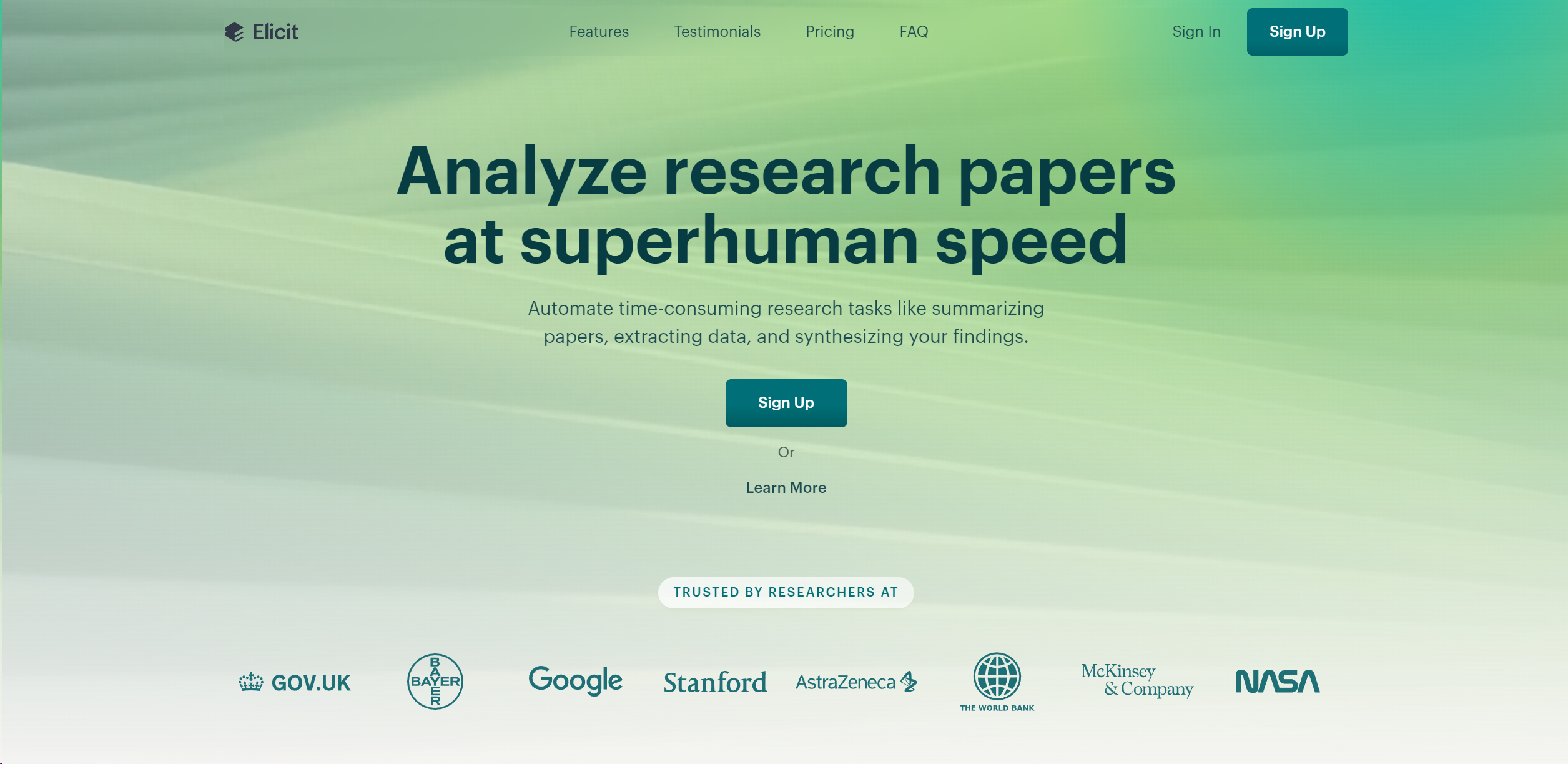
Product Visuals (1 images)
Strengths
- Time-Saving: Elicit has been reported to save users up to 5 hours per week by automating research tasks that are typically time-consuming.
- Cost-Effective: Pilot projects have demonstrated Elicit's ability to cut research groups' costs and time by 50% through automation of data extraction tasks previously done manually.
- Highly Accurate: Though not perfect, Elicit strives for high accuracy in its outputs and provides sources for verification, fostering trust in its synthesized findings.
- Flexible and Accessible: With options for both free and paid plans, Elicit is accessible to individual researchers, teams, and institutions, offering tailored solutions to meet diverse research needs.
Limitations
- Learning Curve: New users may require some time to familiarize themselves with the tool's advanced features and full capabilities.
- Limited to Empirical Research: Elicit is optimized for empirical domains involving experiments and concrete results, which may limit its applicability in theoretical or non-empirical areas.
- Accuracy Concerns: While Elicit aims for high accuracy, the reliance on AI means that users should verify the synthesized information, which could add an extra step to the research process.
What You Get
Key Features
- Database Access: Elicit provides access to a vast database of 125 million academic papers, allowing users to search for relevant research using natural language queries.
- Summarization and Data Extraction: It offers the ability to quickly summarize research papers and extract data into organized tables, significantly reducing the time spent on these tasks.
- Synthesis of Findings: Users can find themes and concepts across multiple papers, helping in the synthesis of broad research findings.
- User-Friendly Interface: The tool's intuitive design ensures a seamless user experience, making it easier for researchers to navigate and utilize its features effectively.
- ProsTime-Saving: Elicit has been reported to save users up to 5 hours per week by automating research tasks that are typically time-consuming.Cost-Effective: Pilot projects have demonstrated Elicit's ability to cut research groups' costs and time by 50% through automation of data extraction tasks previously done manually.Highly Accurate: Though not perfect, Elicit strives for high accuracy in its outputs and provides sources for verification, fostering trust in its synthesized findings.Flexible and Accessible: With options for both free and paid plans, Elicit is accessible to individual researchers, teams, and institutions, offering tailored solutions to meet diverse research needs.ConsLearning Curve: New users may require some time to familiarize themselves with the tool's advanced features and full capabilities.Limited to Empirical Research: Elicit is optimized for empirical domains involving experiments and concrete results, which may limit its applicability in theoretical or non-empirical areas.Accuracy Concerns: While Elicit aims for high accuracy, the reliance on AI means that users should verify the synthesized information, which could add an extra step to the research process.
Best For
- Academic Researchers: Leveraging the tool for conducting literature reviews and synthesizing findings across numerous papers.
- Biotechnologists: Employing Elicit for staying informed on the latest research developments in biotechnology.
- Machine Learning Professionals: Using the tool to find relevant datasets and research papers in the fast-evolving field of machine learning.
- Healthcare Professionals: Utilizing Elicit for researching medical issues and advancements.
- Uncommon Use Cases: Utilized by policy analysts for gathering evidence-based insights; adopted by legal researchers for finding precedents and related academic discussions.
Integrations
PDF Uploads: Users can upload their own PDFs for analysis, making it a versatile tool for personal research libraries. Export Options: Elicit Plus allows exporting results to RIS, CSV, and BIB formats, facilitating integration with other research tools and software. Natural Language Processing: Leveraging advanced NLP, Elicit integrates seamlessly with the research workflow, interpreting complex queries with ease.
Similar Tools

Weekly Issue
⚡
Research tools · weekly digest
The AI Weekly — free in your inbox
New AI tools, pricing changes, expert picks, and hidden gems — curated by Mr. Spark every week. Join 5,000+ readers who stay ahead of the AI curve.
No spam, ever
Unsubscribe anytime
100% free