
Pricing Details
Open Source Core: Free to use under the Apache 2.0 license for both personal and commercial self hosted deployments. Enterprise and Hosted Offerings: Any managed services, enterprise support, or private deployments are handled directly with EverMind and do not have public price tiers as of now. Disclaimer: Please note that pricing information may not be up to date. For the most accurate and current pricing details, refer to the official EverMemOS website.
Product Visuals (1 images)
Strengths
- True Long-Term Consistency: Helps agents maintain identity and context across days or months, instead of forgetting what the user said ten messages ago.
- Open Source and Enterprise Ready: Apache 2.0 licensing and a transparent GitHub codebase suit security-conscious teams that want on-prem or VPC deployments.
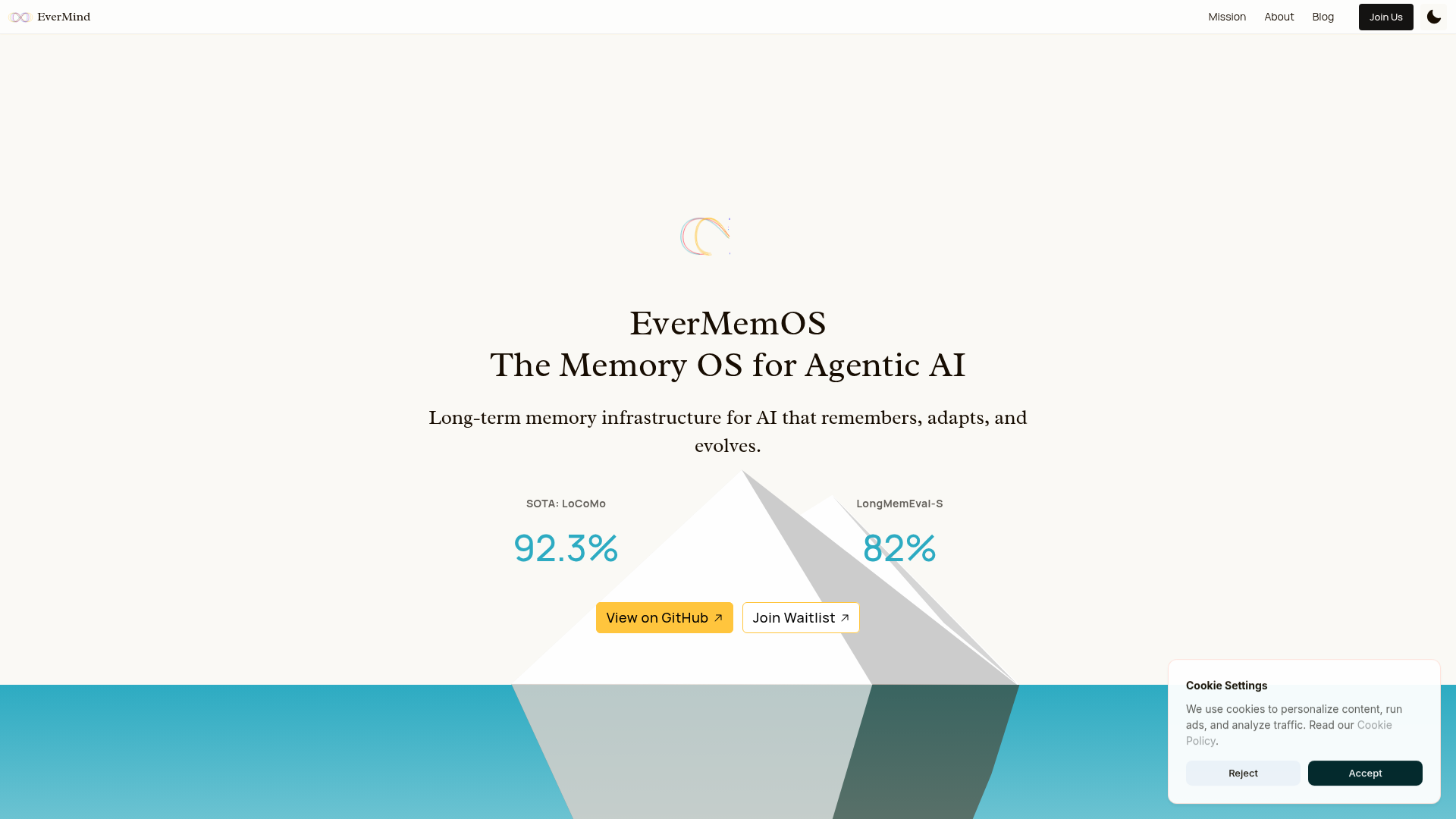
- Serious Benchmark Credentials: Strong results on LoCoMo and LongMemEval-S give technical buyers evidence that the memory system holds up under pressure, not just in demos.
- Rich Retrieval Modes: From ultra fast BM25-only recall to multi round LLM-based retrieval, teams can tune latency, cost, and quality for each use case.
- Good Getting-Started Experience: Quickstart scripts, sample data, and interactive chat demos make it practical to see the whole memory loop working in under an hour.
Limitations
- Nontrivial Infrastructure Footprint: Requires Docker plus MongoDB, Elasticsearch, Milvus, and Redis, which can feel heavy for small teams or hobby projects.
- Early Ecosystem: Although maturing quickly, it still has fewer out-of-the-box integrations than established search or vector stores.
- External LLM Dependency for Advanced Modes: Agentic retrieval relies on third party LLM APIs, so costs and latency depend on whichever model provider a team chooses.
Building your AI toolkit?
Save EverMemOS and 1,000+ tools — free with Google, no spam
What You Get
Key Features
- Four-Layer Memory Design: Separates agent behavior, long term storage, indexing, and integration, so teams can drop EverMemOS in as a shared memory backbone across multiple agents and applications.
- Structured MemCells and Multi-Level Memories: Converts raw conversations into atomic MemCell units, then builds episodes, profiles, preferences, semantic knowledge, and more, giving agents rich, queryable memories instead of loose text blobs.
- Hybrid Retrieval and Agentic Recall: Combines BM25 keyword search via Elasticsearch, vector retrieval via Milvus, reciprocal-rank-fusion (RRF), and optional LLM-guided multi round retrieval, so agents can recall what matters without dragging in irrelevant context.
- Living Profiles and Personalization: Maintains continuously updated user profiles that learn preferences, habits, and relationships over time, letting agents answer like a colleague who actually remembers previous chats.
- Benchmark-Driven Memory Evaluation: Ships with an evaluation stack aligned with EverMind’s EverMemBench and related tools, and has reported state-of-the-art scores such as 92.3 on LoCoMo and 82 on LongMemEval-S for long term memory reasoning.
- Developer-Friendly Infrastructure: Provides Docker Compose to spin up MongoDB, Elasticsearch, Milvus, and Redis, plus a Python API server with REST endpoints for memorization and retrieval, along with ready-to-run demos.
- ProsTrue Long-Term Consistency: Helps agents maintain identity and context across days or months, instead of forgetting what the user said ten messages ago.Open Source and Enterprise Ready: Apache 2.0 licensing and a transparent GitHub codebase suit security-conscious teams that want on-prem or VPC deployments.Serious Benchmark Credentials: Strong results on LoCoMo and LongMemEval-S give technical buyers evidence that the memory system holds up under pressure, not just in demos.Rich Retrieval Modes: From ultra fast BM25-only recall to multi round LLM-based retrieval, teams can tune latency, cost, and quality for each use case.Good Getting-Started Experience: Quickstart scripts, sample data, and interactive chat demos make it practical to see the whole memory loop working in under an hour.ConsNontrivial Infrastructure Footprint: Requires Docker plus MongoDB, Elasticsearch, Milvus, and Redis, which can feel heavy for small teams or hobby projects.Early Ecosystem: Although maturing quickly, it still has fewer out-of-the-box integrations than established search or vector stores.External LLM Dependency for Advanced Modes: Agentic retrieval relies on third party LLM APIs, so costs and latency depend on whichever model provider a team chooses.
Best For
- AI Infrastructure Teams in Tech Companies: Embedding EverMemOS as the shared memory layer that multiple internal agents query for user, project, and system context.
- Product Teams Building Agentic Assistants: Powering copilots and chat assistants that must remember prior sessions, evolving requirements, and user preferences.
- Customer Support Automation Providers: Using long term conversation and account history so bots respond with proper context instead of treating each ticket as isolated.
- Research Labs and Academic Groups: Exploring long context reasoning, memory architectures, and evaluation using EverMemOS plus EverMemBench and related tooling.
- Uncommon Use Cases: Utilized by digital therapeutics and wellness startups experimenting with emotionally consistent companion agents; Adopted by internal enablement teams that want HR or IT assistants to remember each employee’s prior interactions.
Similar Tools
AI Agents tools · weekly digest
The AI Weekly — free in your inbox
New AI tools, pricing changes, expert picks, and hidden gems — curated by Mr. Spark every week. Join 5,000+ readers who stay ahead of the AI curve.