
Pricing Details
Custom Enterprise Plans: Guardrail Technologies appears to operate on a direct sales model with tailored deployments, demos, and contracts based on each organization’s size, usage patterns, and risk requirements. Pilot and Proof-of-Concept Engagements: Prospective customers should expect to scope a pilot or phased rollout rather than switch it on with a simple self-service subscription. Disclaimer: Please note that pricing information may not be up to date. For the most accurate and current pricing details, refer to the official Guardrail Technologies website.
Product Visuals (1 images)
Strengths
- Strong privacy posture: The alias-based masking approach protects personal and confidential data while keeping AI performance usable, which is attractive for regulated and data-sensitive environments.
- Enterprise-friendly governance: Built-in audit logs, policies, and access controls give security, legal, and compliance teams the oversight they expect from other core enterprise systems.
- Vendor independence: By operating as an independent trust layer, it lets customers change or mix AI providers without rewriting their safety and privacy controls every time.
- Improved AI adoption with less friction: Security teams can approve more AI initiatives because Guardrail Technologies gives them tools to constrain risk instead of defaulting to “no.”
- Designed for scale: Modular architecture and alignment with major cloud platforms make it suitable for organizations rolling out AI to many departments and applications.
Limitations
- Enterprise focus over SMB: Positioning and deployment are clearly aimed at midmarket and large enterprises, so smaller teams looking for a quick self-serve option may find it out of reach.
- Initial rollout effort: Capturing policies, roles, and workflows inside the platform requires planning across security, IT, and business units, which can slow first deployments.
- No transparent public pricing: Lack of published plan tiers or unit pricing makes early budgeting harder and forces interested teams into a sales process before they can estimate total cost.
Building your AI toolkit?
Save Guardrail Technologies and 1,000+ tools — free with Google, no spam
What You Get
Key Features
- AI Control Panel and Trust Layer: Centralizes configuration of models, prompts, data sources, and agents in one workspace, sitting between users and underlying LLMs so teams can enforce consistent policies across many tools.
- Context-preserving data masking: Replaces sensitive inputs with safe, context-aware aliases instead of blunt redaction, so models still get useful signal while actual identifiers, secrets, and IP stay in the customer’s domain. Authorized roles can later unmask values when permitted.
- Prompt Protect and policy rules: Scans prompts for confidential information, policy violations, or risky language, then blocks, rewrites, or routes them according to customizable rules while preserving enough context for the AI to remain effective.
- Granular role-based access control: Applies fine-grained permissions to who can view, send, or unmask sensitive data, aligning access with job functions and reducing both insider risk and accidental exposure.
- Audit trail and real-time risk intelligence: Logs every prompt, response, and user action, allowing security teams to review incidents, run investigations, and surface alerts when activity deviates from policy or appears fraudulent.
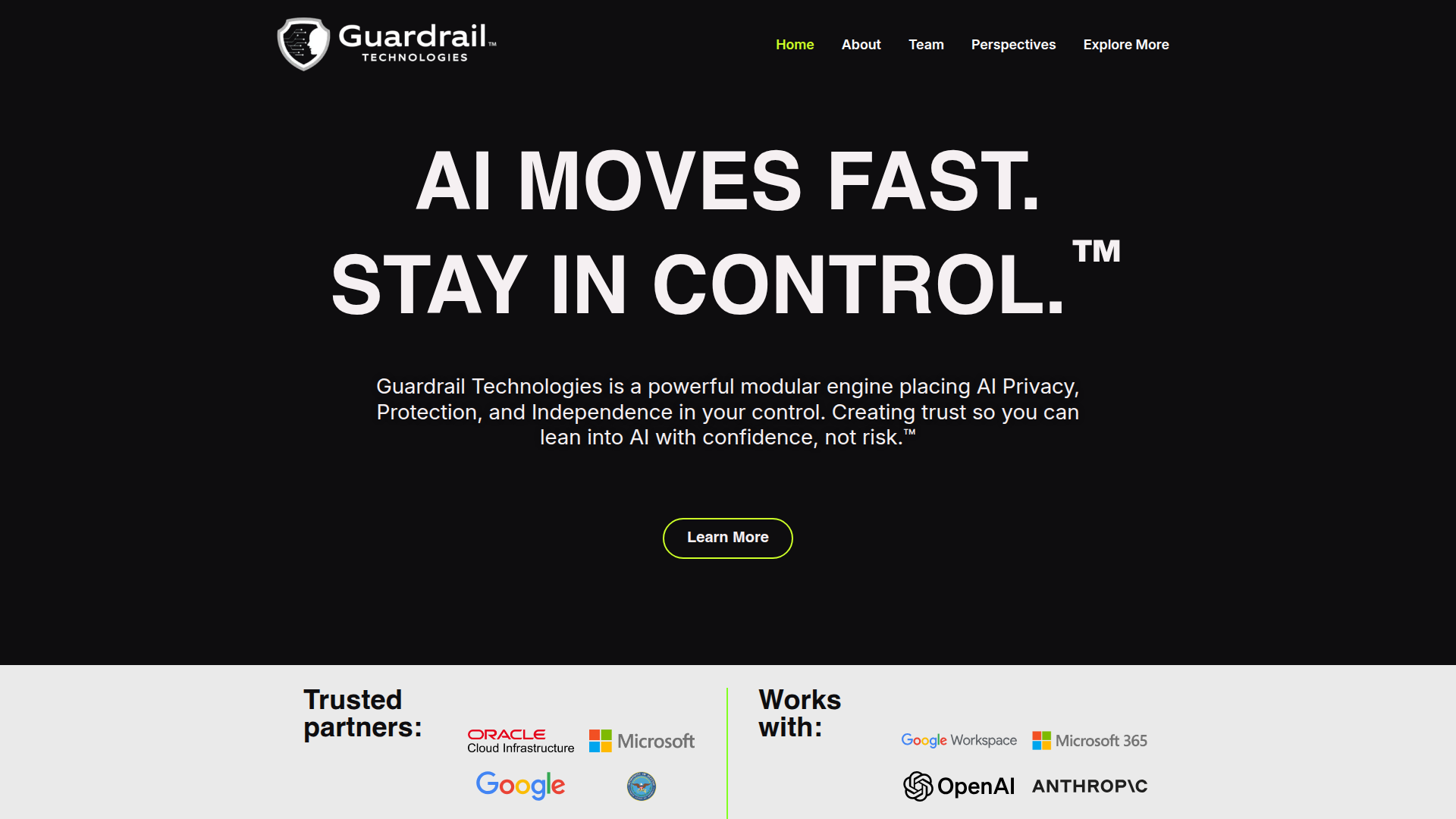
- Model and cloud agnostic integrations: Works alongside Microsoft, Google, OpenAI, Anthropic, Oracle Cloud Infrastructure, and more, so organizations can standardize protection across different vendors and workloads without giving up choice.
- ProsStrong privacy posture: The alias-based masking approach protects personal and confidential data while keeping AI performance usable, which is attractive for regulated and data-sensitive environments.Enterprise-friendly governance: Built-in audit logs, policies, and access controls give security, legal, and compliance teams the oversight they expect from other core enterprise systems.Vendor independence: By operating as an independent trust layer, it lets customers change or mix AI providers without rewriting their safety and privacy controls every time.Improved AI adoption with less friction: Security teams can approve more AI initiatives because Guardrail Technologies gives them tools to constrain risk instead of defaulting to “no.”Designed for scale: Modular architecture and alignment with major cloud platforms make it suitable for organizations rolling out AI to many departments and applications.ConsEnterprise focus over SMB: Positioning and deployment are clearly aimed at midmarket and large enterprises, so smaller teams looking for a quick self-serve option may find it out of reach.Initial rollout effort: Capturing policies, roles, and workflows inside the platform requires planning across security, IT, and business units, which can slow first deployments.No transparent public pricing: Lack of published plan tiers or unit pricing makes early budgeting harder and forces interested teams into a sales process before they can estimate total cost.
Best For
- Security, Risk, and Compliance Teams: Using the platform to govern how employees and internal tools interact with LLMs, enforce acceptable use policies, and retain a defensible audit trail.
- Highly Regulated Industries: Banks, insurers, healthcare providers, and public-sector organizations that want to experiment with AI on sensitive workloads without exposing personal or confidential data.
- Enterprise IT and Data Platform Groups: Standardizing AI access, routing, and model choice across business units, so each new AI use case does not require its own one-off guardrail solution.
- Product and Innovation Teams: Embedding generative or agentic capabilities into customer-facing products while offloading privacy, safety, and logging responsibilities to a centralized trust layer.
- Uncommon Use Cases: Pilots inside universities exploring AI governance and safety testing; nonprofit or mission-driven groups experimenting with AI on highly sensitive health or crisis-support data while insisting on strong privacy controls.
Similar Tools
Workflows tools · weekly digest
The AI Weekly — free in your inbox
New AI tools, pricing changes, expert picks, and hidden gems — curated by Mr. Spark every week. Join 5,000+ readers who stay ahead of the AI curve.